Habit-tic deformity
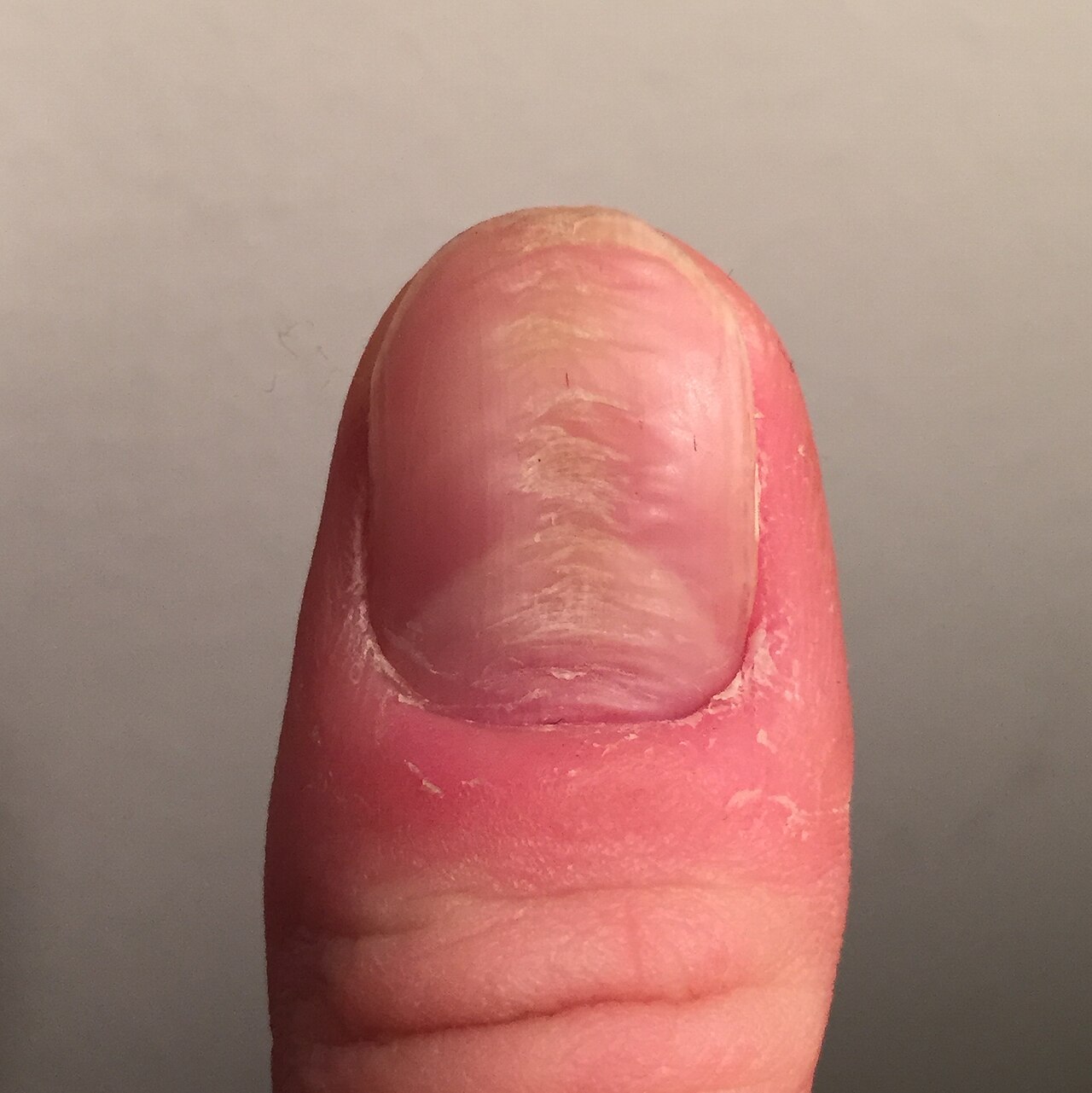
Nail deformity from habitual skin picking trauma.

Wikipedia / Wikimedia Commons
Habit-tic deformity results from repeated external injury to the nail matrix. The main signs are horizontal ridges that span the full width of the nail, often forming a fir-tree pattern, and significant damage or complete loss of the cuticle. Discoloration along the ridged area is also typical. While most common on the thumbs, it can appear on other nails as well. This condition should not be mistaken for median nail dystrophy, which is rarer and includes an additional vertical canal-like ridge.
The underlying cause is long-term trauma from habitual skin picking around the nail—a body-focused repetitive behavior that tends to intensify during stress, boredom, or inactivity. Historically, habit-tic deformity has been associated with anxiety, tic disorders, and obsessive-compulsive disorder. However, unlike OCD compulsions, the picking is not preceded by anxiety nor followed by relief.
Stopping the trauma to the nail is an effective treatment. Proven methods include applying cyanoacrylate adhesive to create an artificial cuticle that supports nail root growth, and using bandages or tape to prevent picking.
- field
- Dermatology
- known_for
- Horizontal nail ridges from habitual skin picking
- common_sites
- Thumbs (most common), other nails (less common)
- cause
- Long-term external trauma to nail matrix from skin-picking
- associated_conditions
- Anxiety, tic disorder, obsessive-compulsive disorder (disputed link)
Lore & Background
Habit-tic deformity is caused by long-term external trauma to the nail matrix as a result of skin-picking around the affected nail. The underlying cause is habitual skin picking as a body-focused repetitive behavior, which often worsens during times of stress, boredom, or inactivity. In the past, the condition has been linked to anxiety, tic disorder, and obsessive-compulsive disorder, but there is no preceding anxiety and subsequent relief felt by an individual after picking, differentiating it from compulsions associated with OCD.
Reader's Guide
Habit-tic deformity is significant as a distinct nail condition resulting from a repetitive behavioral pattern rather than an internal disease. Its recognition helps differentiate it from similar conditions like median nail dystrophy, which includes a canal-like vertical ridge. The condition underscores the role of external trauma in nail pathology and highlights the importance of behavioral interventions. Treatment focuses on cessation of trauma, with effective methods including application of cyanoacrylate adhesive to form an artificial cuticle and promote nail root growth, as well as wearing bandages or tape to prevent picking. The condition's association with stress and boredom points to its behavioral roots, though its distinction from OCD compulsions is noted in the literature.
Did You Know?
- Habit-tic deformity is caused by long-term external trauma to the nail matrix from skin-picking.
- The condition is most commonly seen on the thumbs.
- It is not to be confused with median nail dystrophy, which includes a canal-like vertical ridge.
- Cessation of trauma is an effective treatment, and cyanoacrylate adhesive can be used to form an artificial cuticle.
Clinical Appearance and Identification
Habit-tic deformity presents a distinctive visual signature on the nail plate that clinicians can recognize at a glance. The hallmark feature is a series of horizontal ridges that traverse the full width of the nail, producing what is often described as a fir-tree pattern. These ridges are not isolated to one area; they span the entire nail surface. Alongside the textural changes, patients frequently exhibit discoloration in the affected region, and the cuticle area shows significant damage or is entirely absent. While the condition most prominently affects the thumbs, it can also manifest on other digits, though with considerably less frequency. The combination of these features—the transverse ridging, the compromised cuticle, and the characteristic overall shape—makes the deformity readily identifiable in a clinical setting, provided the examiner is familiar with its presentation and knows what to look for during a routine nail inspection.
Behavioral and Psychological Underpinnings
The root cause of habit-tic deformity lies not in an intrinsic nail disorder but in sustained mechanical damage inflicted upon the nail matrix. The mechanism is repetitive skin-picking behavior directed at the area surrounding the affected nail, a pattern classified as a body-focused repetitive behavior. This picking tends to intensify during periods of stress, boredom, or general inactivity, suggesting that the behavior serves as a self-regulatory response to internal states. Historically, the condition has been associated with anxiety disorders, tic disorders, and obsessive-compulsive disorder. However, a critical distinction separates habit-tic deformity from true OCD-related compulsions: individuals with the deformity do not experience a preceding wave of anxiety that is then relieved by the act of picking. This absence of the anxiety-relief cycle is a key differentiator that clinicians use to distinguish the behavioral pattern underlying habit-tic deformity from the compulsive rituals seen in obsessive-compulsive presentations.
Therapeutic Approaches
Management of habit-tic deformity centers on a single fundamental principle: halting the ongoing mechanical trauma to the nail matrix. Once the repetitive picking behavior ceases, the nail has the capacity to regenerate, and the ridged appearance gradually resolves as new, healthy nail tissue grows in to replace the damaged area. Several practical strategies have demonstrated effectiveness in supporting this recovery process. One approach involves applying cyanoacrylate adhesive to the nail surface, which serves a dual purpose: it creates an artificial cuticle barrier that discourages further picking, and it promotes healthy growth at the nail root. Another commonly recommended method is the simple use of bandages or adhesive tape over the affected area, providing a physical deterrent that interrupts the habitual picking cycle. Both strategies share the common goal of protecting the vulnerable nail matrix while giving the tissue adequate time to heal and the individual an opportunity to break the ingrained behavioral pattern.
Differential Diagnosis and Clinical Scope
A critical aspect of diagnosing habit-tic deformity is distinguishing it from conditions that present with superficially similar nail changes. The most important differential is median nail dystrophy, a rarer condition that can initially appear comparable to the untrained eye. However, median nail dystrophy is characterized by the presence of a canal-like vertical ridge running down the nail, a feature entirely absent in habit-tic deformity, where the ridging is exclusively horizontal. This distinction in ridge orientation—transverse versus longitudinal—provides a reliable visual criterion for differentiation during examination. In terms of clinical scope, habit-tic deformity shows a strong predilection for the thumbs, where the combination of frequent hand use and the natural tendency to pick around the nail makes these digits particularly vulnerable. While the condition can extend to other fingers, such cases are notably less common, reinforcing the thumb as the primary and most characteristic site of presentation.
Gallery

More in Symptoms 1-24
Spotted an error? Know more?
This is a living reference — every entry is fact-audited, and reader corrections feed straight into our audit queue. Suggest an edit · See this site's audit record